Categories
Uncategorized

Time Capsule Tidbits

One of the few material possessions I inherited from my grandmother Goody is a book entitled The Concise Oxford Dictionary of English Literature, first published in 1939 and reprinted in 1942.

I love this book for many reasons, among them: the perspective of the editors is extremely British-centric, much of the information is so antiquated as to verge on fiction, the writing of the entries is delightfully snobby, and the totality is a time-capsule of the English literary landscape eighty years ago, a landscape so unlike the literary landscape of today this book might be about life on another planet where they also happen to have Shakespeare, Dickens, and Jane Austen.

Here, for your enjoyment, are a handful of entries I especially enjoyed during my latest perusal of the goodly tome.

Southcott, Joanna (1750-1814), a religious fanatic. In 1792 she began to write doggerel prophecies and to claim supernatural gifts, and in time attracted a very large number of followers. She died of brain disease, leaving a sealed box with directions that it should be opened at a time of national crisis. It was opened in 1927 and was found to contain nothing of interest.

Macaulay, Rose, contemporary author among whose chief works are: Potterism (1920), Dangerous Ages (1921), Told By an Idiot (1923) Orphan Island (1924), all novels; also two volumes of verse. She is notable for a deft and epigrammatic style and for her wide reading.

Burnell the Ass, the hero of the Speculum Stultorum of Wireker, Burnell, an ass who wishes to acquire a larger tail, goes to Salerno and to Paris to study, meets with various adventures, and finally loses his tail altogether.

Genius, in classical pagan belief, the tutelary god or attendant spirit allotted to every person at his birth, to govern his fortunes and determine his character; also the spirit similarly connected with a place.

Hesperia, the western land for the Greek poets was Italy. The Roman poets similarly gave the name to Spain.

Lover, Samuel (1797-1868), Irish novelist and song-writer, is remembered for his ballad, and the novel developed out of it, Rory O’More (1836), which deals with the tragic events in Ireland in 1798 and also for his novel Handy Andy in which he developed the whimsical aspects of Irish character.

Wilcox, MRS. ELLA WHEELER (née Wheeler) (1855-1919), American poet and journalist, described as the most popular poet of either sex and of any age, read by thousands who never open Shakespeare. She began to publish poems at the age of seven, and her last volume Poems of Affection was published posthumously in 1920. Her Collected Poems were published in 1921.

fin

The Way Things Go from Todd’s album Lounge Act In Heaven

Categories
Uncategorized

Singing Along Again

Some of you let me know you enjoyed singing/reading along with my song The Way Things Go from my album Lounge Act In Heaven, and one of you asked for the lyrics to my song Really Really You from my album Through the Fire.

So here are links to Really Really You on YouTube, Pandora, Apple, and Amazon, and here are the lyrics to the song.

Really Really You

I’ve always liked lizards, feel lucky when I see one

I like pelicans, too. In fact, I’d like to be one.

I like hummingbirds, and I like chickadees, too

I like walking on the beach

And I really really like you

I like hanging out with little kids, they hunger for the truth

I like spending time with teenagers,

they take me back to my youth

Yeah, they take me back to when I was seventeen

My life stretched out before me, no end to be seen

Oooh chorus

I love women, I do. I like men

I’m pretty much a Taoist, with a little touch of zen

I like your sister, she’s cool, and I like your brother, too

And I really really really really really really really like you

I’ve always liked lizards, feel lucky when I see one

I like pelicans, too. In fact, I’d like to be one.

I like koala bears, and I like kangaroos

I like walking in the woods

And I really really like you

Ooh chorus

I love women, I do. I like men

I’m pretty much a Taoist, with a splash of cayenne

I like your sister, she’s jazz, and I like your brother, too

And I really really like you

I really really like you

Happy Solstice!

Categories
Uncategorized

Sugar Mornings

the improvisor

Last week’s blog entry recounted the origin of the song “You Are The One” from my new album of songs Lounge Act In Heaven. Readers continue to let me know they’re enjoying these song origin stories, so now I’ll tell the story of the instrumental ‘Sugar Mornings’, Track 7 on Lounge Act In Heaven.

When I was in my mid-thirties I made my one and only attempt to write my autobiography. I thought I should first write something about my parents’ lives to set the scene for my birth. Then I realized to do my folks justice I should write about their parents, too. But to understand my grandparents, the reader would need to know about their parents, my great grandparents, and how they got to America and California. When I found myself mired in a seventeen page description of life in a Jewish village in Poland in the 1870s, I gave up the autobiography and returned to fiction.

I feel a little bit this way about ‘Sugar Mornings’ because the life from which the music sprang is most of the story.

My parents were children and teenagers during the Great Depression. Thus though they were fast moving up from barely scraping by to middle class by the time I was born, they continued to live frugally and raised my siblings and me to be frugal, too. When each of us turned twelve, we were expected to earn our own money for things other than food, basic clothing, and the utility bills. My older sisters became zealous babysitters and I pulled weeds for neighbors and babysat, too.

To say that my parents were neurotic about money is a grand understatement. As a teenager, I was well aware that my parents were by then wealthy compared to most Americans, yet they pinched every penny and were painfully ungenerous to their progeny. This had a huge impact on my siblings and me and would shape the courses of our lives.

When I dropped out of college at nineteen, I reckoned the less money I needed in order to survive, the more time I would have to work on my stories and novels and songs. So for the next ten years I lived on next to nothing and could get everything I owned onto a Greyhound bus with me whenever I needed to pick up and move. Save for a couple idyllic years of living in communes in Santa Cruz, I rarely had an easy time making ends meet from week to week.

Then in 1978 Doubleday published my novel Inside Moves. And though the book was nearly remaindered (taken out of print) before publication day, Inside Moves had a big pre-publication paperback sale followed by a movie sale. (You can read the remarkable history of Inside Moves on the Inside Moves page of my web site.)

And so for the first time since dropping out of college I had so much money I didn’t have to worry about paying the rent and having enough money for groceries.

In 1979 I rented a little cottage in Santa Cruz and gave myself fulltime to writing and composing. Heaven. What’s more I fell in love with a woman who I fervently hoped would return the favor. And though she did not, my infatuation with her inspired several songs including ‘Sugar Mornings’.

The title came from a letter I wrote to a friend, the letter lost, the gist remembered. I call these mornings when I wake free of worry, sugar mornings, the sweetest mornings I’ve ever known.

I wrote lyrics for ‘Sugar Mornings’ at the time I composed the music, but after all these decades I only remember the first few lines. “Sugar mornings and midnight dreams, lying here by myself it seems, kinda crazy that you are there, faraway and…”

This past summer, the summer of 2019, forty years after composing ‘Sugar Mornings’, and just a few weeks after I brought out my album Dream of You, I was noodling around on the piano one evening and stumbled on the beginning of ‘Sugar Mornings’. I hadn’t played the piece in many years and might have let the tune sink back into the depths had not Marcia heard me playing and said, “I hope you’re going to put that on your next album.”

To which I replied, “I will if you’ll play a cello part.”

She said she would play a cello part and that inspired me to learn ‘Sugar Mornings’ again. I do not read music, so everything I compose must be practiced many times to take hold and not be forgotten. After much hunting around and many dozens of run-throughs, I was able to play ‘Sugar Mornings’ again with confidence and élan.

Peter Temple came to my house to record the piano parts for Lounge Act In Heaven. We then gave those piano parts, including ‘Sugar Mornings’, to Gwyneth Moreland who came up with delightful accordion parts for all the songs. When her part for ‘Sugar Mornings’ was recorded and roughly mixed with my piano part, I gave the mix to Marcia and she composed her cello part. After we recorded Marcia’s cello part, Peter and I mixed the three parts, played the new mix for Marcia, she made suggestions, we refined the mix again, and so forth. Eventually we came up with the version of ‘Sugar Mornings’ you can hear on Lounge Act In Heaven, what one friend called “a sweet nostalgic soundtrack for the opening and ending credits of a classic French film yet to be made.”

Categories
Uncategorized

Light Song

after storm sky


Last week’s blog entry recounted the origin of ‘A Wedding Song’, one of the twelve songs on my new album Lounge Act In Heaven. Having heard from readers that they enjoyed hearing the history of that song, I will now describe how the title Lounge Act In Heaven came to me and also tell the origin story of ‘Light Song’, the last song on the album.

(Aside: I grew up in the era of concept albums, when the order of songs was very important to both recording artists and those listening to their albums. Thus today I still put lots of thought into the order of the songs on my albums, though the streaming downloading web-crawling algorithms care little for that sort of thing.)

In the spring of 2019, I produced my CD of songs Dream of You on which I collaborated for the first time with Gwyneth Moreland, a marvelous singer and accordion player, Mendocino music celebrity, and my neighbor. A raft of new songs were inspired by our collaboration and I invited Gwyneth to come hear the new songs and try some harmonizing, and to see how her accordion playing sounded with my guitar and piano playing.

We began with five guitar songs for which her delightful accordion playing and singing were just what I was looking for. Then we moved to the piano and I played and sang two of the piano tunes. Again, her accordion and singing seemed ideal for those songs. And then I began to play ‘Light Song’, a song I wrote many years ago but had never recorded, though it is one of my all-time favorites.

I began to play the slow ceremonial progression, Gwyneth found a lovely accordion accompaniment, and then something rare and wonderful happened: Marcia emerged from her studio with her cello and joined us—the music of our trio as beautiful as anything I have ever heard.

The next day I wrote to my friend Max and said, “While playing ‘Light Song’ with Gwyneth and Marcia, I felt I was in a lounge act in heaven.”

I wrote the piano music for ‘Light Song’ circa 1994, the year before I moved to Berkeley from Sacramento. My inspiration came from a modern dance concert I attended in a small theatre in Davis. I was so taken by one of the dances that I went back the next night to see that particular dance again.

The name of the dance and the accompanying music elude my memory now, but I remember the dance was marvelously ceremonial, four women entering in stately procession, priestesses, each of them slowly and gracefully finding her place on the stage.

I was under the spell of that dance for the next several weeks and improvised many piano pieces I imagined as accompaniments to ceremonies. Out of those improvisations came the processional ‘Light Song’.

A decade later, while I was living in Berkeley, my mother died and came to me in a dream at the moment of her death. She was young and beautiful as I remembered her from my childhood. As she approached me, she metamorphosed into two translucent discs, each the size of a small butterfly that fluttered to the ground and dissolved into the soil.

In describing the dream to a friend I wrote, “Maybe there is no end, only transformation.”

Over the next few years whenever I played the music for ‘Light Song’ I would improvise lyrics, and the first line to stick was, “Here there are no endings, only tides of change.” But it was not until I moved to Mendocino in 2006 and became a denizen of the redwoods that the rest of the lyrics came to me.

th_Ceremonies-489

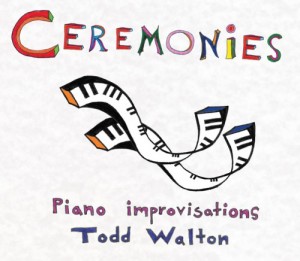
In 2011 I created an album of ceremonial piano improvisations entitled Ceremonies, my most successful album to date if Internet radio plays are indicators of success, but I did not include “Light Song” on that album. Something kept me from recording ‘Light Song’ until just the right elements arrived to join my voice and piano—Gwyneth’s voice and accordion, and Marcia’s cello.

 Light Song

here there are no endings

only tides of change

here the path goes ever wending

through the forests born of rain


there’s a shadow of a raven

gliding over fields of stone

life and light have found each other

we are none of us alone


come with me and join the dancing

add your voice to evening’s song

find a place to watch the turning

of the day to night and dawn


give yourself to silent wonder

shout your feelings to the sky

bless this chance to share the gift of life

never mind the reasons why