When we first moved to our two acres in the redwoods eleven years ago, I endeavored to grow vegetables in the ground despite the warnings from neighbors that the redwood roots would defeat me. In my ignorance, I believed otherwise and dug massive quantities of roots from my beds every few months until after five years of futile labor, I finally I hurt my back one too many times and surrendered.
2023
Thus began the era of tub farming. Easy living with great
results! Yesterday I prepared one of my orchard tubs by turning the soil and
adding aged chicken manure and compost, and then planted seeds of chard,
lettuce, sugar snap peas, and arugula.
In another tub I planted potatoes next to last year’s chard. Zucchini and tomatoes and other vegetables that like hot weather, or at least warm weather, do not grow well here a mile from the coast outside of greenhouses, and we do not have a greenhouse.
When we came to look at this place before we bought it, the first thing I saw was this magnificent old tree in our woods, her twisted trunk having saved her from felling when the area was clear-cut a hundred years ago. Her twisted trunk means that usable lumber cannot be made from her trunk. We believe she is more than two-hundred-years-old.
We mostly heat our house with a woodstove. We buy tan oak from Frank’s Firewood and harvest soft wood from our two acres. Every year I clear brush and thickets of young hemlocks from which I make great piles of kindling. We also occasionally have trees felled that are threatening to fall on the house or on our neighbors’ houses, and from these trees we get soft wood to go with the tan oak in our woodstove fires.
We recently had five yards of gravel delivered for various projects, and every day I move a few wheelbarrow loads to places around the property. I am very careful not to load the shovel or the wheelbarrow too full lest I hurt my back in the process, something I do with annoying regularity these days.
fin
Really Really You a song by Todd from his new CD Through the Fire.
I went to bed last night thinking about fences and walls. We recently removed a large section of the old fence topped with barbed wire that surrounded our two acres when we bought the place. All our neighbors and visitors have told us how much they love the fence being gone, how beautiful the forest vista, and how spacious this whole part of the neighborhood feels now.
When I was growing up
there were no fences or walls dividing the lots in our suburban neighborhood,
which gave a marvelous spacious feeling to our environment. Everyone, adults
and children and dogs, felt connected and could
connect easily with each other. Fifty years gone by, high walls now surround
all those lots, and the neighborhood feels like a vast prison.
I was going to write
more about walls and fences, but the dream I had last night is much more
interesting to me, and I thought you might find the dream interesting, too.
*
I’m walking on a dirt road on the coast of Spain in summer. I’m younger than I am now, wearing a T-shirt and jeans and I’m barefoot and have no possessions.
I come to a house on a
hill with a view of the ocean. There are no other houses anywhere to be seen. In
search of food, I enter the house and find three women there. I don’t know them
and they don’t know me. Nevertheless, they accept me into their midst and one
of them says of another of the women, “She’s a guitarist from New York.”
This woman, the
guitarist from New York, has long brown hair and is very beautiful to me. She’s
wearing a skimpy purple dress and invites me to embrace her. We embrace and
kiss and disrobe, and she leads me away from the others and we make love.
The other women inform
me they are a lesbian couple, and one of them says she’s never been with a man
and would like to try. So she and I have sex, which upsets the guitarist from
New York. She gives me a look to say From
now on you will only have sex with me. Okay?
I give her a look to
say Will do.
Now I’m doing some
kind of work on the place and need a shovel. A moment later I’m in a big city
in the 1930s in winter. There are electric trolleys and automobiles from that
era, and the people are dressed in the fashions of those times.
I wander around until I find a hardware store. I choose a shiny new shovel and an axe, and on my way to the counter with them I remember I have no money. So I lean the shovel and axe against the counter and walk out of the store intending to go to my parents’ house in California to get some money.
I walk up a street where all the buildings collapsed long ago and trees and vines are now growing in the rubble. I come to a bus stop amidst the ruins and ask a man if buses still stop here. The man speaks English with a thick Spanish accent and says, “Yes. Buses still come here.”
A crowded bus arrives.
I get on and say to the driver, “I don’t know how much it is. I want to go to
the airport.” I get out my wallet and it is bulging with fifty and
hundred-dollar bills. The driver gives me a ticket and two dollars.
I take a seat beside a woman wearing a heavy coat, her hair and face covered by a bandana. She removes her bandana and let’s her hair down. The guitarist from New York!
“Why do you need to fly to California?” she asks, pursing her lips for a kiss, “when your wallet is full of money?”
I learned how to
backpack from my father in the 1950s, and in the 1960s I was fortunate to go
backpacking with some of the people who had the first recorded ascents of many
of the peaks of the Sierras.
There was no giardia in
the waters of the Sierras in those days, so there was no need to filter or boil
water from the lakes and streams. One of my great pleasures was lying on my
belly and drinking directly from a flowing stream. I remember the first time we
had to filter Sierra water. I was in my twenties. I was so sad about the loss
of purity in those splendid mountains, I cried every time I had to filter our
water.
This was also before the
advent of lightweight packs and lightweight tents and lightweight sleeping bags,
before armies of backpackers swarmed the wilderness. My pack for a week in the
Sierras weighed upwards of sixty pounds, and we so rarely met other backpackers,
every meeting was memorable.
We were ever on the
lookout for edible food that needed only water added to make a viable meal.
Forget tasty. Edible. I was a fly fisherman, and in those days so few people
visited the places we went, the fishing was always good and we had trout for
breakfast and supper.
One day a backpacking friend
touted me on a rice dish available in a cardboard box, the ingredients needing
only water to turn into some sort of pilaf. I got some, cooked it at home,
found it edible, barely, and got two more boxes to take on a backpacking trip.
Our first day we hiked
for seven hours carrying our hella heavy packs over two high passes, and we didn’t
reach our destination until darkness was falling. Exhausted and having no time
to fish, we made our cooking fire and boiled a pan of water to cook the rice pilaf.
Yes. A cooking fire. This
was when so few people ventured into the Sierras there was always plenty of
dead wood to be gathered for fires, no permits were required, and there was no
need to carry a little propane stove. When the water came to a boil, we poured
in the desiccated rice grains, stirred occasionally, and twenty minutes later
scooped the gruel into our Sierra Club cups.
Oh my God. The pilaf tasted
like a three-star Michelin entrée, our mighty exertions and our extreme hunger
making the crummy food gourmet.
*
When I was in my twenties I was a vagabond for a few years. I hitchhiked all over America and Canada, carrying all my possessions in a big backpack weighing fifty to seventy pounds depending on how much food and how many books I was carrying. I also toted a cheap guitar in a flimsy case and played for hours while waiting for rides. I was essentially a highway backpacker.
During the summer of 1971 I found myself in Stowe, Vermont with a few dollars in my wallet and needing work. Stowe is now a swank resort town, but in 1971 it was a small country town. I inquired in the hardware store if they knew of anyone needing a laborer. The friendly fellow working there said he’d make a few calls and to come back in a half hour. To pass the time, I went to the bakery to get a loaf of bread.
The gal in the bakery
sold me a big day-old loaf for twenty-five cents. When I inquired about places
to camp, she said I could pitch my tube tent in her backyard. I asked if she
knew of anyone needing a laborer, and she said there was a guy tending a
warming hut on the nearby Long Trail, which is part of the Appalachian Trail,
who wanted somebody to cut and chop wood for the hut. She said he came into the
bakery every few days to buy cookies and bread, and to complain about the
absence of bagels.
The guy at the hardware
store didn’t come up with any work for me, so after spending the night in the
bakery gal’s backyard, I hiked two miles up a trail that connected with the
Long Trail, hiked another mile or so north along the Long Trail, and introduced
myself to the fellow tending the warming hut there.
I don’t know how things
are run on those trails nowadays, but in 1971 hikers did not camp wherever they
wanted along the way and had to stay in these warming huts, which were one-room
cabins with a hearth, a woodstove, and wooden platforms for sleeping bags. There
was no electricity and the outhouse was unpleasant.
The fee to stay overnight was fifty cents. The keeper of the hut collected the fees, made sure there was plenty of firewood, swept out the hut, cleaned the outhouse, kept the water barrel in the hut full, and had a walkie-talkie in case of emergencies.
The fellow tending the
hut was named Bernard. He lived in Brooklyn where he was born thirty-five years
before I met him. He spoke with a thick Brooklyn Jewish accent and was a chess
master with a high ranking. Tall and bearded, Bernard was volubly unhappy about
spending his summer in the mountains. He was there at the suggestion of his
psychiatrist who felt a break from city life would help lessen his anxiety and
depression and anger.
Within thirty seconds of
my arrival, Bernard asked me, “Do you play chess?”
“Not well,” I replied.
“Let’s play,” he said grimly.
A moment later we were
sitting on the deck of the hut with a chessboard between us. I asked him to
remind me how the horse moved and he gave me a look of dismay. “Please tell me
you’re kidding. You must know that piece is called a knight.”
“Now I do,” I said,
laughing.
Not amused, Bernard checkmated me with ease three or four times, and said, “You’ll get better.”
He then explained his
job included foraging in the surrounding woods for well-aged fallen trees and
branches, sawing them up, and splitting them into firewood for the hut. Never
having wielded a saw or an axe, this labor was torture for him. He would pay me
five dollars a day and cover my food if I would work for him.
I stayed a week, which
was all I could take of Bernard. He was desperately lonely and talked endlessly
about his mother and father, chess tournaments, his most challenging rivals in
the chess world, and his difficulties with women. Fortunately he did not
accompany me on my wood gathering expeditions, so I had daily respites from his
laments.
Hikers would start
arriving in the afternoon. Bernard would collect the fees and inquire of each
hiker, “Do you play chess?” Occasionally a good chess player would come along
and Bernard would delight in games he always won. He and I played many times
and I got a little better, but not so it made a difference to Bernard.
In the mornings, hikers
would cook their oatmeal and move on. I would sweep out the hut, pump water
from the spring to refill the warming hut barrel, clean the outhouse, and then go
forth with saw and axe to gather wood from the surrounding forest. In my
absence, Bernard would read, write letters and postcards, and because I was in
the vicinity, he walked into town every other day to mail his letters, get his
mail, make phone calls, and buy food.
We got to be friends,
though Bernard never asked me anything about my life. What he learned about me came
from overhearing conversations I had with hikers who were more inquisitive than
he. By contrast, I knew so much about
Bernard I could have written a long depressing novel based on his anguished
life. Working title: Such A Headache I’ve
Got.
At the end of a week,
with thirty-five dollars in my pocket (a fortune to me in those days) I bid Bernard
adieu and left the mountains for another stint on the road.
I was recently on the table of Bibi, our most excellent acupressurist, and as she pressed hot points on various meridians in my left foot, she asked with some urgency, “Are you frustrated?”
I’m sure you’ve had the experience of someone asking
you a question that initially catches you by surprise, and then upon further musing
the question leads to a valuable insight or two. Well that’s what happened to
me when Bibi asked, “Are you frustrated?”
Had she asked, “Feeling a little anxious?” I would have replied, “Is the Pope Catholic?” Or if she’d asked, “A little depressed?” I would have answered, “Am I human and alive on earth in 2023?” But frustrated? About what? And though I couldn’t think of anything off the top of my head I was frustrated about, the word burrowed into my consciousness and eventually opened a rusty door in the cranial archives.
My mother was in many ways the embodiment of
frustration. Possessed of an extremely high IQ, a gifted musician and actress,
and one of the first women to graduate from Stanford Law School, she subsumed
her talents to raise four children with little help from our abusive alcoholic father.
My mother was Jewish. Growing up during the Great Depression when anti-Semitism in America was ferocious, her Jewish parents changed their last name from Weinstein to Winton to improve their chances of survival, and they instructed my mother to disguise and deny her Jewishness, and if possible marry a non-Jew, which my mother did. She then raised her children without letting us know we were Jewish, which I’m sure was another source of stress and frustration for her, as it certainly turned out to be for my siblings and I.
My grandmother Goody, my mother’s mother, was also frustrated. Raised in an Orthodox Jewish family, she, too, was a marvelous singer and actress, but was forbidden from pursuing those arts by her deeply religious parents who equated Show Biz with the Devil. Hence for much of her life Goody felt her destiny had been stolen from her.
What does this have to do with me? Are you kidding? What does this not have to do with me? Yet until Bibi asked me if I was frustrated, it did not occur to me to include frustration in the sum total of neuroses that add up to yours truly.
What is frustration? In simple terms, frustration is a feeling of dissatisfaction arising from wanting something we don’t have. My mother wanted to do something with her talent and didn’t feel she could until her kids were grown. When that day arrived, she became a Special Ed teacher and eventually practiced law part-time. She also wrote children’s plays and was the leading light of an excellent play-reading group.
I was in my mid-twenties the first time I visited my mother at the law firm where she began practicing law at the age of fifty. I was stunned. Who was this serene, thoughtful, funny, brilliant person handling complicated cases with ease and aplomb? Where was my antsy, negative, complaining, beleaguered mother steeling herself for the next blast of abuse from my father? She was transformed! She was, part-time for a few golden years, no longer frustrated.
Recalling these things about my mother and
grandmother, I could feel deep in my meridians how I had inherited my mother’s habit of frustration, and I also understood
that my decision to dedicate my life to writing and music was in essence the
path my mother and grandmother had longed to pursue, and not doing so was the cause of their terrible frustration.
And though I did follow my passion, I, too, was persistently frustrated until I was well into my fifties because what I wanted more than anything was to be so successful with my writing and music that my disapproving parents would finally approve of me, which was never to be.
Now I’m seventy-three. Over the course of the
last twenty-five years my primary motive for writing and composing has evolved
from yearning to succeed in a big way into wanting to share what I create however
I can.
So why did my meridians tell Bibi I was frustrated? Because my desire to be recognized beyond my small circle of friends lives on in my subconscious and rose from the depths when we came out with our new CD Through the Fire. And who rides the horse of such desire? None other than the headless horseman of frustration.
And because frustration is a huge energy drain and gets in the way of enjoying life and doing good work, not to mention messing with my meridians, I have turned over several new leaves since that fateful moment on Bibi’s table.
One of those newly turned leaves is to begin each
day with a dance of gratitude for my marvelous friends and for the infinite
possibilities awaiting me in my studio and living room and kitchen and backyard
and watershed.
I’m happy to report: daily gratitude dancing
obliterates frustration.
Our friend Jeff said to me the other day, “I don’t believe in reality.”
I wish I could remember what I said to him right
before he said that, but I can’t.
The moment Jeff said, “I don’t believe in
reality,” my awareness of reality shifted. Not that I stopped believing in
reality, but I began to see the world differently. How so? Hard to say.
You will recall the scene in the prophetic movie
The Wizard of Oz when Dorothy and the
Scarecrow and the Tin Woodsman and the Lion are standing before the big screen
on which is projected the frightening head and face of the supposed Wizard of
Oz and they are quaking in fear of him and he is telling them he can’t help
them, when Toto, Dorothy’s dog, possibly the sharpest member of the cast,
discovers an old man standing in a booth adjacent to the screen, and the booth
turns out to be the projection room, the image on the screen an illusion.
“Pay no attention to the man behind the
curtain,” says the Wizard of Oz on the screen as voiced by the old man in the
projection room.
He might have said, “Don’t believe in reality!
Believe instead in the nonsense on the screen intended to entrance you and
entrap you and empower me at your expense.”
*
Yesterday I was on my way into Corners of the Mouth, the worker-owned food cooperative in Mendocino where I shop twice a week, and there were two people, a man and a woman, standing in front of the store gazing into their smart phones. The man said, “Mixed reviews.” The woman replied, “Seems more like a bulk foods place.”
As I passed them I said, “Pay no attention to
the man behind the curtain.”
“Excuse me?” said the man, frowning at me.
“It’s a great store. Full of wonders,” I said,
smiling at him. “I’ve been shopping here multiple times a week for seventeen
years. Every time I go in I discover something new. The produce is
grandiloquent, the employees spectacular, their selection of chocolate bars
inspiring.”
The man looked at his phone. “Says the layout is
confusing.”
The woman blinked at me and said, “That was from
The Wizard of Oz. Pay no attention to
the man behind the curtain.”
“Right you are,” I said, entering the store and
inhaling of the magnificence.
Which is to say, reality seems to be largely
what we make of things. Descartes said, “I think therefore I am.” To which I will
add, “If you think what is projected on your screen is reality, so it shall
be.”
*
My mother was essentially mistrustful of reality whenever things were going well. In other words, she was always expecting something bad to happen. It was almost as if she wanted something bad to happen. I don’t think she did, but her expectation was so strong it might as well have been the desire for disaster.
I inherited this mistrust of happiness from her,
which created in me a lifelong propensity for self-sabotage. I am ever amazed
at how this manifests on both the physical and emotional planes in my life, and
I’m not kidding when I say I really don’t know how I made it to seventy-three.
*
My mother said the thing she disliked most about getting old was all her friends were dying. She did not say that what she disliked most about getting old was all her friends were falling and breaking various bones and hitting their heads, but for me that seems to be the era we have entered vis-à-vis our friends, along with some of them dying, too.
As one who has fallen many times throughout my
life, though not recently knock-on-wood, I can tell you that in my reality every time I fell I was either
needlessly hurrying or not paying close attention to what I was doing, and
probably both those things. My most recent injury resulting from needlessly
hurrying and not paying attention was to smash my bare toes on a rock
protruding from the path I was on, the result of which was a broken toe, an
infected toe, a wonky way of walking for some weeks, aches and pains from
lopsided posture due to compensating for foot pain, and so forth ongoing.
Why was I hurrying and not paying attention
after a delightful barefooted walk on the beach? The short answer is: I’m an
idiot.
*
Why do we needlessly hurry and not pay attention to what we are doing? We might say the answer is different for each of us. We might also say the answer is the same for all of us. For one reason or another we are not content to fully inhabit the present moment. We are entrained to move forward, to keep going, to stay busy, to keep ourselves entertained, our brains stimulated, even if by junk. We don’t know very well how to saunter and to pay close attention to what we’re doing and to what’s going on around us.
Marcia and I take a walk on the headlands south
of Mendocino every few weeks, and after a two-mile jaunt we come to the end of
the trail overlooking a rock outcropping just offshore on which harbor seals
like to roost for several hours a day. Sometimes there are a dozen or more seals
on those rocks, sometimes just a few, and sometimes there are none. The seals
are light gray and dark gray and various shades of brown, their colors very
close to the colors of the outcropping.
Now here’s an interesting thing to me about this
outcropping and those seals. We have arrived at the point overlooking the
outcropping a hundred or so times in my life, and the first thing I do when we
arrive there is to count the seals. And many of those times, my first count
misses at least one and sometimes more of the seals. My second count usually
includes all the seals, but sometimes it takes a third careful scanning before
I clearly see all the seals.
When I was a little boy and I would tell my grandfather Casey something I
thought was terribly important or interesting, he would feign amazement and
say, “Who knew?”
The first few times he responded in this way I replied, “I did.” Eventually I came to realize Who knew? was his way of saying, “Oh my gosh,” or “Isn’t that something,” or “How unexpected.”
By the time I was a teenager, I knew that many Jewish people used the
expression, and to this day when I encounter someone who comes out with Who knew? (usually with a tone of humorous
irony) I feel an immediate affinity.
What does this have to do with our new CDThrough the Fire? Well… when we were making the album we had about forty-five minutes of music to present. A standard CD holds about seventy-two minutes of content and we thought it would be fun to fill some of the remaining space with a story or two of mine, one of the Healing stories and…
“Oh please read Of Onyx and Guinea
Pigs,” said Marcia, emphatically. “It’s both believable and beyond
believable, and it’s so funny.”
So I recorded the memoir in Peter Temple’s studio where we’ve made all our albums and where I’ve recorded all my audio books, and Peter thought the story was fiction, which it is not, though it certainly could be.
Now that Through the Fire is
out in the world and we’ve gotten responses from friends and DJs, Of Onyx and Guinea Pigs is by far the
most talked about track on the album.
My response is “Who knew?” And the answer is, Marcia did.
*
a link to a site with all the downloading/streaming/listening options for Through the Fire.
Goody (far left) and Casey (far right) and Howard (in the back) with my mother and father, my sister Wendy on my father’s shoulder, my sister Kathy beside me, circa 1952
When I was seventeen I visited my grandparents Goody and Casey, my mother’s parents, in Los Angeles. They were living in a tiny apartment in a seedy neighborhood of old buildings soon to be replaced by newer ones.
This was in striking contrast to how they lived for most of the 1940s and 50s and 60s when they owned a large house with a swimming pool in an upscale neighborhood in Los Angeles. They had a cook and housekeeper, drove expensive cars, and at the height of their riches owned fifty apartment buildings in nice parts of the city, a second home in Palm Springs, and hundreds of acres on the outskirts of Los Angeles awaiting development.
Todd and Casey circa 1954
I remember as a little boy riding around in Casey’s convertible Lincoln
Continental from one apartment complex to another where Casey would inspect the
premises, confer with his managers, and exchange niceties with his many
renters.
Casey was a gambler. One of his famous sayings was, “I wish I had a
dollar for every dollar I’ve lost playing gin rummy.” Then he would arch his
eyebrow and say, “For that matter, I wish I had a dollar for every dollar I won playing gin rummy.”
He did not read books and spent many an evening at their country club playing Gin Rummy for ten and twenty dollars a point. He would never play golf just to play golf. There had to be money on the game. He once lost fifteen thousand dollars on nine holes of golf, and this was in the late 1950s when for fifteen thousand dollars one could buy a nice house in San Carlos and a big beach house in Santa Cruz.
Goody, by contrast, was an intellectual interested in psychology and art, an avid collector of Asian antiques, and left the moneymaking entirely to Casey. She wrote long thoughtful letters to her friends and grandchildren, and was a fantastic story teller.
Goody at a Hollywood party posing with the very young Red Skelton and the rather young William Bendix, 1940s?
Casey’s son, my uncle Howard, was an even bigger gambler than Casey. A
successful entertainment lawyer, he bet on college sports, pro sports, played
poker several times a week in high stakes games, and gambled with real estate.
Then came the Big Deal. Casey partnered with Howard and two of Howard’s associates
and they bought a huge chunk of land on Wilshire Boulevard, several acres.
Today those acres are covered with office buildings and high-rise apartment
buildings and the land is worth many billions of dollars.
Casey’s dream was to build an exclusive retirement community and hotel with an adjoining office complex, entertainment venue, and medical center. He mortgaged all his apartment buildings, all his land, everything he owned, and put every penny into this incredibly ambitious project.
Shortly before ground was to be broken on the Wilshire dream, Howard and
his colleagues pulled out of the deal and Casey lost everything. I don’t know
the details of how and why this happened, but literally overnight Goody and
Casey went from being fabulously wealthy to being paupers dependent on my
parents.
Even more bizarre, Howard and his wife and kids moved into Goody and Casey’s opulent home, and Goody and Casey became frequent visitors there. Casey talked his way into sharing an office with a low-end real estate shyster and life went on.
Goody was born into a poor family in the Jewish ghetto of Detroit in 1900. Casey grew up in Flint, Michigan where his family owned a dry goods store. Casey attended college on an athletic scholarship. When he and Goody were first married, they were desperately poor for several years until Casey’s real estate deals started paying off.
Goody at 80, circa 1980
So there I was in Goody and Casey’s tiny apartment, seeing them for the
first time without their great riches. It was Goody’s sixty-fifth birthday. I
said to her, “What a fascinating life you’ve had.”
To which she replied, “If you live to fifty you’ve had a fascinating life.”
Her answer puzzled me at the time. When I turned fifty I recalled Goody’s proclamation and felt I knew what she meant. To be born and survive the helplessness of infancy, to learn to walk and talk and socialize, to grow into adulthood, to experience love and loss and pain and happiness and sorrow, and to reach an age when we are no longer young and the body is no longer capable of doing what it could do so easily when we were ten and twenty and thirty and forty, is to have had a fascinating life.
*
Good news. We just got our first radio plays for our new CD Through the Fire. A station in Georgetown California and a station in Milwaukee Wisconsin played Really Really You. A station in Bloomington Indiana played Rico, a station in Warren Vermont played Real Good Joe, and a station in Boise Idaho played Rico, too.
Mazel tov!
a link to a site that will give you all the downloading/streaming/listening options for Through the Fire.
If perchance you have been following the adventures of Healing Weintraub, we are pleased to tell you the saga has reached a turning point. Which is to say, there WILL be more Healing Weintraub stories following a hiatus of unknown duration.
In the meantime, we are VERY EXCITED to report that the first twenty-some adventures have been assembled into a single manuscript and the process of revising the collection into a novel of stories, rather than a collection of freestanding stories, has begun.
Inspired rewriting is underway and myriad redundancies are being eliminated while new details and unexpected twists and turns join the fun. When the Healing manuscript is reconstructed and polished and thoroughly vetted, we hope to publish the opus as an actual book and downloadable e-book AND bring forth an audio version of yours truly narrating the tales.
Please stay tuned for a
birth announcement regarding Through the
Fire, our new CD of tunes and stories soon to debut physically and
digitally.
Interviewer: Aren’t you
afraid the title of your new collection of stories Why Are You Here? might be a bit overwhelming to prospective
readers? The magnitude of the question?
Todd: The title is not Why Are You Here? The title is Why You Are Here, and it is not a question.
Interviewer: Oh. Wow.
Somehow my brain flipped those two words around and made it a question. Ah. Now
I see. So… Why You Are Here. Doesn’t that
strike you as a bit presumptuous suggesting you know why we are here?
Todd: Why You Are Here is the title of one of
the stories in the collection, and the title of that story comes from something
one of the characters in the story says.
Interviewer: What does the
character say?
Todd: He says to another character, “How marvelous it must be to know
why you are here.”
Interviewer: Why does he
say that? Because the other character claims to know why he’s here?
Todd: The short answer
is Yes.
Interviewer: What’s the
long answer?
Todd: The long answer
is… why not read the story?
Interviewer: How can I
get a copy?
Todd: Handsome
paperbacks can be ordered from any bookstore in the world, including your
favorite actual bookstore. And there are many online booksellers offering the handsome
paperback and nifty E-book editions. I will append some handy links.
Interviewer: Excellent.
Todd: If you enjoy the stories,
I hope you will rate Why You Are Here and
other stories and consider posting a review, even just a line or two.
Interviewer: For
instance?
Todd: For instance, five
stars would be good, and something like… These
enchanting tales will change your life in the best of ways.
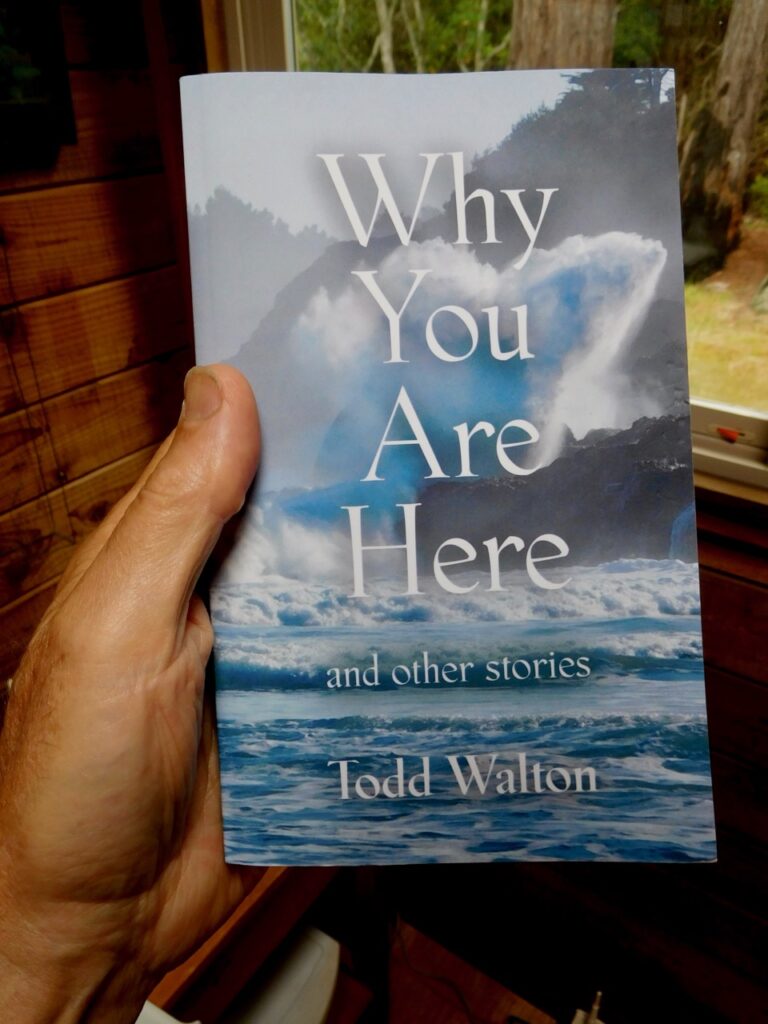
I am pleased to announce
the publication of my new book Why You
Are Here and other stories —
fifteen tales of self-discovery, love, survival, friendship, creativity, and
the quest for meaningful ways to spend this precious life. Set in the town of
Mercy on the north coast of California, these stories may be read as stand-alone
creations or as interconnected tales. The stories in Why You Are Here and other stories first appeared on my blog and were
refined for this collection.
Reader reviews and readers telling friends about the book constitute the entirety of my sophisticated sales strategy. So if you do get a copy of Why You Are Here and other stories and enjoy the collection, it would be fabuloso if you would write a rave review, even just a line or two, and/or rate the book, and tell your friends. If you order the collection from a bookstore or a site that doesn’t post reviews, Goodreads would be a great place to rate the book and post a review.
Handsome paperbacks with a gorgeous cover featuring a photograph I took of a crashing wave may be ordered through Your Favorite Local Bookstore or purchased online. Below are links to online stores selling the paperback and E-book editions.